
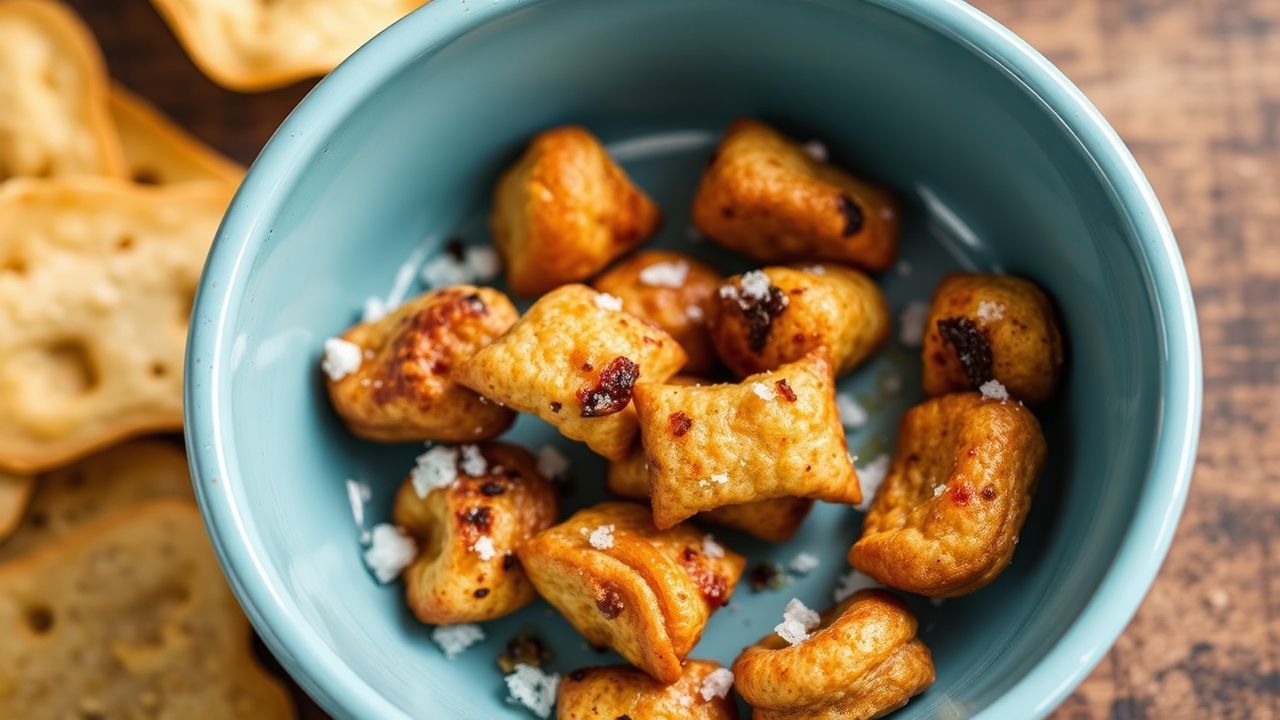

In the world of culinary science, savory snacks combine chemistry and sensory design to deliver memorable bites. Every crunch, aroma, and seasoning choice contributes to how we perceive flavor and satisfaction.
- The Role of Texture and Flavor Balance in Snack Appeal
- Chemistry of Browning and Aroma
- Seasoning Adhesion and Flavor Layering
- Moisture Control and Crunch
- Practical Recipe and Process (Time, Yield, Difficulty)
- Chef’s Notes & Tips for Success
- Serving Suggestions
- Q&A
- What makes a savory snack irresistibly tasty?
- How does salt do more than season?
- Why is texture critical?
- What is the ‘bliss point’ in snacks?
- FAQ
- Balance matters: Salt, umami, and a touch of sweetness steer the flavor profile.
- Texture wins attention: Controlled moisture and structure create lasting crunch.
- Science guides craft: Maillard reactions and water activity management shape aroma and crispness.
The Role of Texture and Flavor Balance in Snack Appeal
The Science Behind Crafting the Perfect Savory Snack begins with two interdependent variables: texture and flavor balance. A snack that delivers contrast—crisp exterior with a tender crumb or an initial crunch followed by a coating of seasoning—creates a layered sensory experience.
Texture signals quality and freshness to the eater, and it directly affects flavor perception. Food scientists quantify texture through measures such as fracture force and acoustic response, and chefs translate those metrics into process controls like bake time and particle size.
Why contrast matters
Contrast in mouthfeel amplifies flavor perception because the brain registers changes more distinctly than monotony. Engineers and sensory scientists use that principle to design snacks that feel dynamic bite after bite.
To build contrast, combine components with different water content, fat levels, or structural matrices. A deliberate contrast reduces sensory fatigue and increases dwell time—people keep eating when each bite reveals something new.
Chemistry of Browning and Aroma
Controlled browning drives complex aromas through the Maillard reaction. This reaction between amino acids and reducing sugars produces hundreds of volatile compounds that we perceive as roasted, nutty, or caramelized notes.
Temperature, pH, and available reactants determine which aroma families dominate. Low-and-slow baking yields different volatiles than high-heat roasting; small formula tweaks change the dominant aroma compounds in measurable ways.
Managing burners and ovens
Use even heat distribution and monitor surface temperature rather than relying on oven dial settings alone. Thermal imaging or an infrared thermometer helps ensure repeatable browning across batches.
When scaling a recipe, track surface temperature, not just time. Surface chemistry follows thermodynamics, so a uniform surface temperature produces consistent Maillard products and predictable aroma profiles.
Seasoning Adhesion and Flavor Layering
Seasoning must stick to the snack long enough to survive handling and release when chewed. Adhesion depends on surface oil, particle size of the seasoning, and the snack’s surface energy.
Binders such as a light oil, egg white, or a sugar syrup increase adhesion by creating a tacky surface during baking. Use minimal binder to avoid sogginess—microfilm coatings suffice to hold powders in place.
Umami elevates savory snacks by increasing perceived savoriness and satiety. Incorporate controlled umami sources rather than excess salt: yeast extracts, aged cheese powders, or dehydrated mushroom concentrates add depth without pushing sodium to unhealthy levels. For background on umami science see umami.
Sprinkling finishing salt after thermal processing preserves crystallinity and delivers a sharper salt burst. That microburst increases perceived saltiness while allowing overall sodium reduction.
Moisture Control and Crunch
Crunch equals controlled water removal. The metric food scientists use to predict crispness is water activity (aw). Lower aw often correlates with longer-lasting crispness and slower staling.
Drying kinetics depend on particle thickness, porosity, and heat transfer. Thin, porous structures dry faster and reach the target aw without overcooking the interior matrix.
Practical moisture strategies
Use pre-bake docking or perforation to speed moisture escape in flat snacks. For fried items, control oil uptake by optimizing batter viscosity and frying temperature to minimize water retention.
Post-bake conditioning (cooling on a single layer at ambient humidity) stabilizes the structure. Store fully cooled snacks in airtight containers with desiccants or barrier packaging to lock in crispness.
Practical Recipe and Process (Time, Yield, Difficulty)
This section preserves the original recipe framework while clarifying process control points. Follow the times and temperatures but monitor texture and surface temperature for consistent results.
Prep: 15 minutes. Cook: 20 minutes. Total: 35 minutes. Yield: ~4 servings. Difficulty: Medium—requires attention to texture and seasoning timing.
Ingredients
- 1 ½ cups rolled oats, finely ground
- ½ cup almond flour, or swap for chickpea flour
- 1 teaspoon smoked paprika
- ½ teaspoon garlic powder
- ½ teaspoon onion powder
- 1 teaspoon sea salt
- ½ teaspoon freshly cracked black pepper
- 2 tablespoons olive oil
- 1 tablespoon honey or maple syrup
- 1 egg white
Instructions
- Preheat oven to 350°F (175°C). Line a baking sheet with parchment for even heat contact.
- Combine ground oats and almond flour in a bowl. Adjust grind size to control final snap.
- Whisk olive oil, honey, and egg white until smooth; this thin binder promotes surface adhesion and glossy browning.
- Mix spices into dry ingredients and fold in the wet mixture until cohesive but not soggy.
- Spread thinly on the sheet and press to a uniform thickness to ensure even drying.
- Bake 15–20 minutes, rotating midway. Remove when edges brown and aroma develops.
- Cool completely on the sheet; cooling completes crisping as residual moisture equilibrates.
Chef’s Notes & Tips for Success
Ingredient swaps change texture and flavor chemistry. Chickpea or sunflower-seed flour increases protein and alters water-binding; expect a firmer matrix.
For extra crunch, sprinkle intact seeds like sesame or pumpkin before baking. They act as micro-structural anchors that fracture audibly on bite.
- Flavor variations: Add cayenne for heat or rosemary for aromatics.
- Storage: Keep fully cooled snacks in airtight containers up to one week.
- Seasoning balance: Blend a small sample with oil and taste on a neutral cracker before scaling.
When reformulating for lower sodium, increase aromatic herbs and umami components to preserve perceived intensity. Adjust the binder or bake time if you alter fat content.
Serving Suggestions
Pair these savory snacks with acidic or creamy dips to create contrast. Acid brightens flavors while fat in dips increases mouthfeel and satiation.
For entertaining, arrange with cheeses and olives on a board. A variety of salt crystals and textures encourages guests to sample more and extend dwell time.
Q&A
Below are concise, evidence-aligned answers to common technical and practical questions about savory-snack design.
These responses draw on sensory science and food-technology fundamentals to give actionable guidance.
What makes a savory snack irresistibly tasty?
Irresistibility arises from calibrated balance among salt, fat, umami, and texture. A crisp bite with layered seasonings stimulates multiple sensory channels and extends eating pleasure.
How does salt do more than season?
Salt suppresses bitterness and boosts perceived sweetness and umami. It also influences protein denaturation and water movement, which affects texture during baking or frying.
Why is texture critical?
Texture governs the timing and release of aroma compounds and flavors. Acoustic and mechanical feedback from a crunchy bite increases perceived freshness and flavor intensity.
What is the ‘bliss point’ in snacks?
The bliss point results from a tuned combination of salt, fat, and sugar that maximizes palatability. Manufacturers use sensory testing to approximate that optimal region for repeat consumption.
FAQ
Quick, practical answers to common formulation and process questions for home cooks and product developers.
How can I reduce sodium without losing flavor?
Cut total salt and add umami-rich ingredients like mushroom powder or yeast extract. Increase aromatic herbs and texture contrast to preserve perceived saltiness.
Can I make these snacks gluten-free?
Yes. Use certified gluten-free rolled oats and swap wheat-based binders for egg white or xanthan gum to maintain structure.
What’s the best way to test crispness?
Measure by sensory bite tests and by observing fracture patterns. For technical labs, use texture analyzers that record fracture force and acoustic emissions.
How do I scale this recipe for larger batches?
Scale ingredients linearly but validate heat transfer and surface-to-volume ratios. Consider convection ovens or conveyor systems to keep surface temperature consistent.
Where can I read more about the science discussed here?
Background science resources: Maillard reaction, umami, and water activity. For ingredient specifics, see rolled oats.
For practical seasoning techniques and additional texture-focused recipes, explore internal resources like mastering savory spices and snack texture guide for deeper step-by-step guidance.
As you experiment, document small changes and sensory outcomes. That disciplined approach turns intuition into repeatable, high-quality snack production.
See also: savory snack