

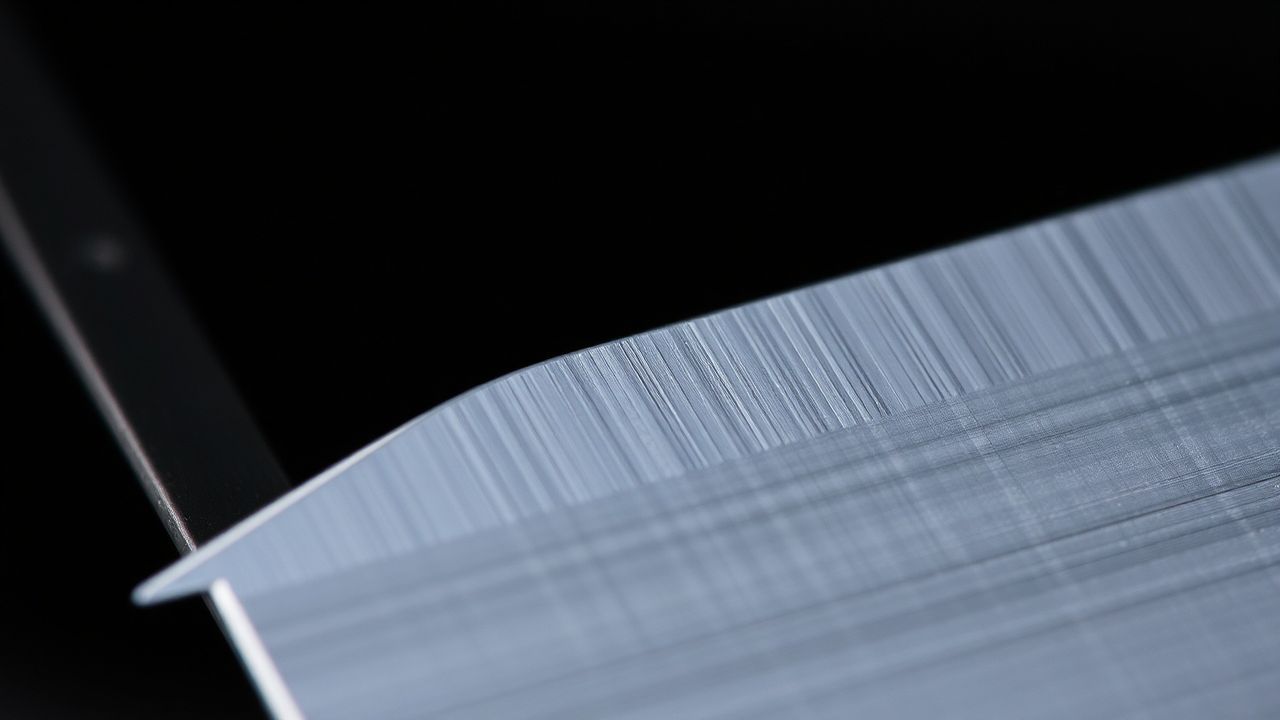

Sharp edges on metal concentrate force into a very small area so cutting tools perform efficiently and predictably. Proper bevel geometry, base material selection, and precise heat treatment determine how a blade performs and how long it stays functional.
- Force concentration: finer tips reduce required cutting pressure and improve control.
- Edge geometry: bevel angle and micro-geometry balance sharpness and toughness.
- Materials & heat treatment: set hardness and wear resistance for reliable edge retention.
- Maintenance: regular honing and correct sharpening prolong service life and safety.
The science behind sharp edges: How edge geometry affects performance
Edge geometry governs how a blade engages material. A narrower bevel reduces contact area and thus the force required to initiate a cut.
Conversely, a wider bevel adds material behind the tip so the edge resists deformation and chipping under load. Designers choose angles to match expected stresses.
Bevel angles and micro-geometry
Typical bevels for hand knives and shears range roughly 15° to 25° per side. Lower angles create keener cuts but trade off impact resistance and edge stability.
At the microscopic level, the tip thickness measures in microns. Micro-serrations and burrs determine initial bite and cut smoothness; progressive polishing reduces drag and refines the cut line.
How hardness and toughness interact
Hardness lets an edge resist wear; toughness limits chipping under impact. Manufacturers tune both through chemistry and controlled thermal cycles to reach target hardness values.
For measurement context, see Rockwell hardness scale, which technicians use to quantify the trade-off between hardness and toughness in cutting tools.
Materials, heat treatment, and manufacturing processes
Steel type and heat treatment set the baseline for a durable edge. Carbon content, alloying elements, and quench/tempering cycles create microstructures that govern wear and fracture behavior.
Manufacturing steps such as forging, precision grinding, and controlled cryogenic treatments refine grain structure and reduce residual stress. Those steps determine how a finished tip holds up in service.
Common blade materials and why they matter
High-carbon steels form fine edges easily but need corrosion control in wet environments. Stainless alloys sacrifice some retention for corrosion resistance and lower maintenance.
Tool steels and powder metallurgy grades deliver superior wear resistance for industrial cutters. For foundational theory on metal behavior, consult metallurgy.
Heat treatment basics
Heat treatment adjusts hardness and toughness using austenitizing, quenching, and tempering cycles. Small changes in temperature and time yield measurable shifts in performance.
Process control and repeatability in heat treatment differentiate consumer blades from professional-grade tools. For a technical primer, see heat treatment.
Sharpening process and maintenance
Sharpening restores intended geometry and removes damaged metal. A controlled sequence from coarse to fine abrasives refines the edge quickly and safely.
Honing realigns the micro-bevel between full sharpenings, reducing metal removal and extending service life. Together, these practices preserve both performance and asset value.
Step-by-step sharpening workflow
Assessment: inspect for chips, rolled edges, and current bevel angle before any abrasive work.
Coarse shaping: use 200–400 grit to re-establish profile when required; maintain consistent stroke angle and pressure.
Medium refinement: move to 800–2000 grit to remove coarse scratches and form a uniform bevel surface.
Polishing: finish with 3k–8k grits or stropping to smooth the micro-edge and reduce friction during cutting.
Honing: run a fine ceramic or steel rod regularly to realign micro-teeth and delay full resharpening.
For tool-specific angle recommendations, match the bevel to the intended use. Lower angles suit slicing; higher angles suit impact or lateral loads.
Practical applications and safety considerations
Different applications require tailored edge solutions. Food service prioritizes a clean slice and corrosion resistance, while industrial stamping prioritizes wear life and impact tolerance.
Medical devices require ultra-fine edges and biocompatible materials; microfabrication tools demand sub-micron control and specialized coatings. For context on precision manufacturing, see microfabrication.
Workplace and tool safety
Sharp edges increase hazard potential; proper storage, blade guards, and clear procedures reduce risk. Train operators on correct cutting angles and controlled force application.
Routine inspection for chips, corrosion, and burrs prevents unexpected failure. Reprofile or replace blades showing excessive wear rather than continuing risky use.
Consistent technique matters more than exotic tools. Use jigs or guides when you need repeatable angles across multiple blades or operators.
Service life and economics
Calculate lifetime cost by combining purchase price, sharpening labor, and downtime. A blade with higher initial cost can be cheaper over its life if it requires fewer regrinds.
Optimize replacement cycles by tracking cutting hours and wear rates. Data-driven maintenance prevents sudden tool loss and improves productivity in production environments.
| Parameter | Typical Value |
|---|---|
| Bevel Angle | 15°–25° |
| Steel Hardness (HRC) | 55–65 HRC |
| Edge Thickness | 2–10 microns at tip |
| Typical Sharpen Time | 15–30 minutes |
For further reading on tool design and selection, study core materials science and controlled manufacturing practices. Well-documented source material improves selection for critical applications.
FAQ
Why do sharp metal edges cut more efficiently?
They concentrate applied force into a smaller area, increasing local pressure at the contact point. That pressure breaks bonds in the workpiece with less total applied force.
From a practical perspective, a keener tip starts a cut sooner and requires less operator effort for the same result.
How does bevel angle affect durability?
Smaller bevel angles yield keener cuts but reduce resistance to impact and side loads. Increasing the angle increases toughness at the cost of initial cutting ease.
Choose an angle that balances required life and the expected mechanical stresses during use.
Can any metal be made sharp?
Most metals can form an edge, but usable performance depends on hardness and toughness. Soft metals deform; brittle materials chip unless alloyed and treated to improve toughness.
Designers select alloys and heat-treatment schedules to create a predictable combination of wear resistance and impact tolerance.
How often should I hone or sharpen tools?
Hone frequently—daily for high-use kitchen or industrial blades. Perform full sharpening when honing no longer restores clean performance or when visible damage appears.
Routine honing reduces cumulative metal removal and preserves profile geometry over the tool’s life.
What maintenance steps increase edge life?
Store blades dry and in sheaths, use appropriate cutting surfaces, avoid twisting loads, and maintain a sharpening schedule. Proper heat treatment and protective coatings also extend life.
Track wear and adjust maintenance intervals based on measured cutting hours and observed degradation.
See also: sharp edges