
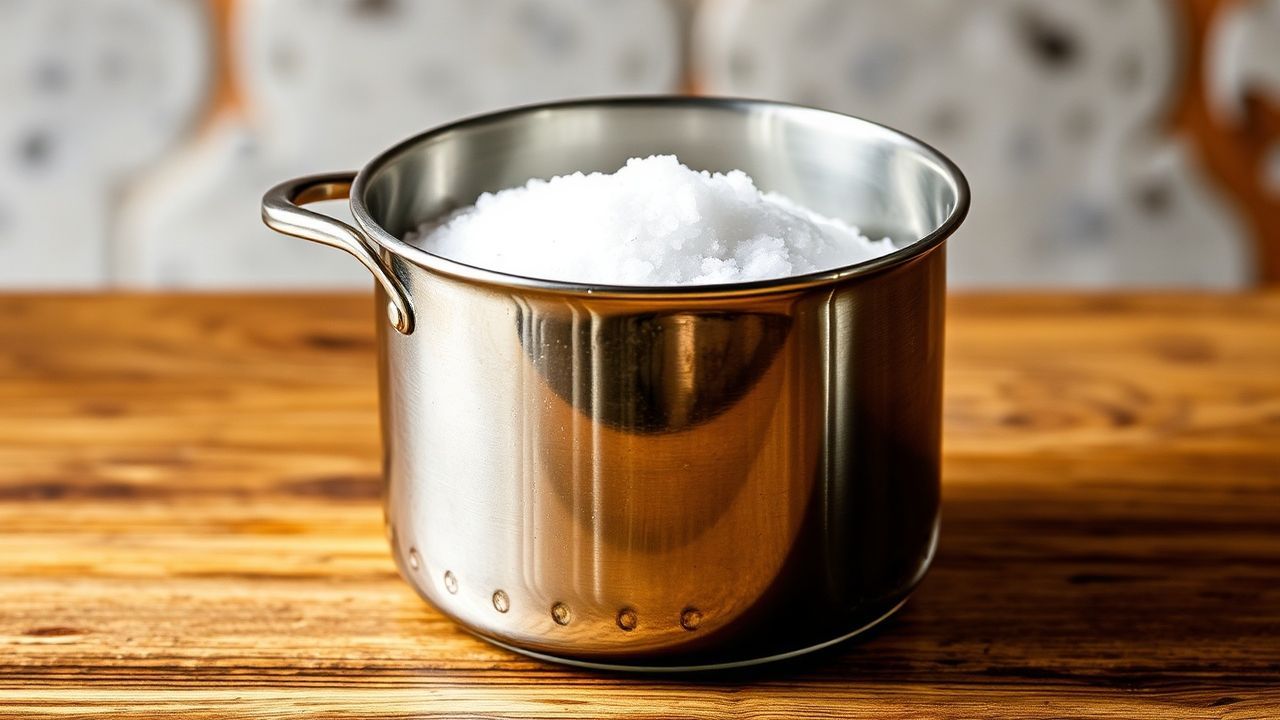

Many cooks ask whether adding salt will make boiling water faster. The short answer is no: dissolved salt raises the boiling point of water slightly, so it cannot speed the time-to-boil in typical kitchen practice. This article explains the physics that determine how salt changes boiling water, shows simple calculations, and gives practical cooking guidance.
- How salt affects boiling water temperature
- Energy and time implications for boiling water in a kitchen
- Practical kitchen impact and common misconceptions about boiling water
- Simple experiment you can run at home with boiling water
- Cooking consequences beyond time-to-boil
- Chef’s practical checklist for faster boiling water
- FAQ
- Does salt ever make water boil at a lower temperature?
- How much does salt raise the boiling point of water?
- Will salt help food cook faster once the pot is boiling?
- Should I add salt before or after boiling?
- Are there safety or dietary concerns with salting water?
- Final practical summary
- Salt raises the boiling point of water slightly, not lowers it.
- The culinary effect is tiny at normal seasoning concentrations.
- Time-to-boil depends far more on pot choice, lid use, and burner power than on salt.
How salt affects boiling water temperature
Dissolving a non-volatile salt like sodium chloride increases a liquid’s boiling point because added ions reduce the solvent’s vapor pressure. This behavior is a classic colligative effect: boiling-point elevation depends on the number of dissolved particles, not their chemical identity.
Quantitatively, you can reference the basic theory in the colligative properties entry, which summarizes how solute concentration drives boiling-point elevation and related phenomena.
Quantifying the change with the ebullioscopic relation
Use ΔTb = Kb · m · i to estimate the boiling-point elevation. Here Kb is water’s ebullioscopic constant, m is the solution molality, and i is the van ‘t Hoff factor that counts dissociated particles per formula unit.
For table salt (NaCl) the van ‘t Hoff factor i ≈ 2 because it dissociates into Na+ and Cl−. Typical culinary doses — for example one tablespoon (~17 g) added to 3.8 kg of water — produce a molality near 0.077 mol/kg and a ΔTb on the order of 0.08 °C. That shift is effectively imperceptible when heating water on household equipment.
Energy and time implications for boiling water in a kitchen
The energy required to heat water increases with the tiny additional temperature rise caused by salt. Compute the extra heat with the specific heat capacity of water: Q = m·c·ΔT. The numbers remain small for normal seasoning levels.
Raising 3.8 kg of water by 0.078 °C uses roughly 1.26 kJ of extra energy. On a 2,000 W burner that extra energy equates to a fraction of a second of additional heating. In practical terms, adding a tablespoon of salt does not make boiling water sooner; physics predicts a negligible delay instead.
Relevant thermodynamic concepts
Two linked concepts are helpful for context: boiling point and vapor pressure. Both determine when a liquid begins sustained phase change at a given ambient pressure.
For concise background on temperature, vapor pressure, and the transition to gas, consult the boiling point page and the vapor pressure entry.
Practical kitchen impact and common misconceptions about boiling water
Cooks sometimes misinterpret what they see. Salted water at a full boil sits at a marginally higher temperature than unsalted water at its boil point. That higher temperature can change cooking chemistry slightly, but it does not shorten the *time* the water needs to reach boiling.
Other effects produce the illusion of faster boiling. For example, stirring when salt dissolves or using a different lid practice changes heat transfer and bubble behavior. Those behavioral or equipment differences explain most anecdotal reports that salt speeds boiling water.
Why recipes say “salt the water”
Recipes recommend salting because salt transfers flavor into starches and proteins during cooking, not because it saves time. When pasta and vegetables absorb salted water, they pick up sodium that improves perceived seasoning.
For properties of the ingredient itself, see the sodium chloride article. It explains why salt dissolves and how it behaves in aqueous solution.
Simple experiment you can run at home with boiling water
You can verify the effect with basic equipment. Use two identical pots, equal water masses, the same burner, and a reliable digital thermometer. One pot stays plain, the other receives a typical culinary dose of salt.
Record the time to the first sustained boil for each pot. Repeat trials multiple times and control lid use and starting temperature. Expect times to match within measurement uncertainty; only larger, laboratory-level salt concentrations produce clearly measurable time differences.
Design tips for valid results
Measure salt by weight to avoid the variability of measuring spoons (kosher versus fine table salt differ in density). Use a digital thermometer and repeat trials to address random noise in household burners.
For a deeper look at heat capacity and related calculations, consult the specific heat capacity resource. That page helps translate temperature shifts into energy and time estimates.
When experiments report large time differences, the cause almost always lies in equipment variation, lid use, or measurement error. In controlled conditions, the salt effect on time-to-boil is negligible for culinary concentrations.
Cooking consequences beyond time-to-boil
Although salt does not speed the approach to boiling, it affects final food quality. Salted cooking water seasons pasta and vegetables internally during hydration, which yields a better-balanced final flavor without only salting after cooking.
Small boiling-point elevations can also influence texture slightly. At household concentrations, these thermal differences remain modest, but they may interact with cooking time and agitation to alter the final bite in sensitive preparations.
Chef’s practical checklist for faster boiling water
Use a lid. Covering a pot traps heat and cuts heat loss dramatically, shortening time to sustained boiling compared with leaving the pot open.
Match pot shape to volume. A wide, shallow vessel brings the same mass of water to near-boil faster than a tall, narrow pot because the surface area exposed to heat is larger.
Choose higher-power heat sources. High-BTU burners or induction elements heat large water masses much quicker than low-power hotplates. These choices move the needle on time-to-boil; salt does not.
FAQ
Does salt ever make water boil at a lower temperature?
No. Dissolved, non-volatile solutes such as sodium chloride raise the boiling point. Only reducing the ambient pressure — for example at high elevation — will lower the boiling temperature.
How much does salt raise the boiling point of water?
It depends on concentration. At culinary levels (a tablespoon in several liters), the rise is a few hundredths to a few tenths of a degree Celsius, negligible for time-to-boil. Laboratory concentrations produce larger, measurable shifts.
Will salt help food cook faster once the pot is boiling?
Technically, food in slightly hotter salted water cooks marginally faster because the liquid can reach a higher equilibrium temperature. However, typical seasoning concentrations give such a small temperature advantage that timing adjustments are unnecessary for most cooks.
Should I add salt before or after boiling?
Add salt when the water approaches a boil or after it boils; both methods season pasta effectively. Adding salt to cold water still seasons food, but the difference in dissolving speed is a practical, not a thermodynamic, factor.
Are there safety or dietary concerns with salting water?
Standard safety applies: avoid splashing and exercise care when adding salt to hot liquids. Also remember that excess salt increases sodium intake; season to taste and consider dietary limits.
Final practical summary
Salt does not make boiling water reach a boil faster. It raises the boiling temperature slightly, which requires a negligible extra energy input and typically delays the time-to-boil by an imperceptible amount.
For cooks seeking shorter wait times, focus on lid use, pot geometry, and burner power. Continue to salt cooking water for flavor benefits, but do not treat it as a time-saving technique.
See also: For reference reading on the underlying physical concepts, consult the linked Wikipedia entries on colligative properties, boiling point, and sodium chloride.
See also: boiling water