
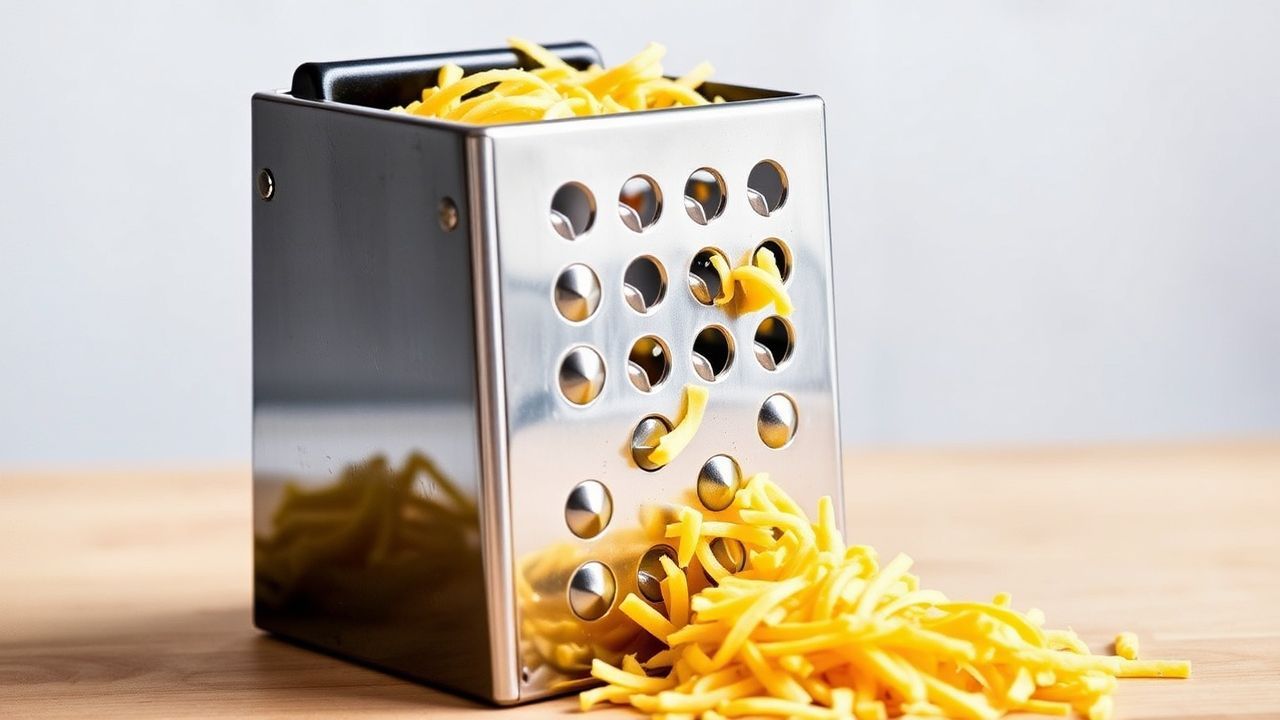

The box grater is a compact instrument that delivers multiple textures from a single tool. Understanding how each face shapes food lets you control flavor release, melt behavior, and mouthfeel with precision.
- How a box grater works
- Anatomy of the four faces
- Coarse shredder (largest holes)
- Medium grater (standard shred)
- Fine grater / zester (small holes)
- Slicer face (single slotted blade)
- Practical use: prep, yield, difficulty, ingredients, and step-by-step
- Maintenance and safety
- Serving suggestions and nutrition
- FAQ
- Match grater face to outcome: choose coarse, medium, fine, or slicer based on texture goals.
- Smaller particles release more aroma: fine grating increases surface area and flavor extraction.
- Material and angle matter: stainless steel construction and tooth geometry reduce effort and wear.
- Simple maintenance extends life: clean promptly and store dry to preserve sharpness.
How a box grater works
A box grater converts a block of food into fragments through shear and tearing forces. Each hole pattern and tooth angle defines whether the action slices cleanly or punches and tears the tissue.
Mechanically, the process combines friction and shear. For context on friction and surface interactions, see friction (physics), which helps explain why texture and effort change across grater faces.
Anatomy of the four faces
Most box graters share a consistent anatomy: a coarse shredding face, a medium grating face, a fine grating/zesting face, and a slicing face. Each face uses a specific tooth geometry and hole size to control particle size and cell rupture.
The typical grater body uses stainless steel for rigidity and corrosion resistance. For material properties and why stainless steel is preferred, consult stainless steel.
Coarse shredder (largest holes)
The coarse face produces thick strands ideal for melting and texture—think cheddar over baked pasta. It cuts by punching out longer ribbons, which preserve more internal structure and slow melting compared with fine particles.
Use the coarse side for vegetables destined for slaws or for cheeses that should retain bite. The larger strands trap air and oil differently, changing mouthfeel and browning behavior.
Medium grater (standard shred)
The medium face yields consistent shreds for even melting or quick cooking. It balances surface area and strand strength, making it a go-to for everyday tasks like grating semi-firm cheeses and carrots.
Medium shreds heat and melt reliably, which matters in gratins or pancakes where uniform cooking is critical. Choose this face when you need controlled melting without complete tissue breakdown.
Fine grater / zester (small holes)
The fine face creates very small particles and is ideal for zesting citrus, grating hard cheeses, or producing a snow-like texture. Smaller particles increase exposed surface area and therefore accelerate aroma and flavor release.
For citrus zest, the micro-shavings release essential oils without pulling bitter pith. For a sense of citrus varieties and their aromatic profiles, see Citrus.
Slicer face (single slotted blade)
The slicer produces uniform ribbons or thin slices when you move produce across it. It functions more like a plane than a shredder and preserves long cell strands for salads or garnishes.
Sliced ribbons change presentation and texture without significantly altering cooking time. Use the slicer for zucchini ribbons, cucumber slices, and other applications where intact ribbons improve mouthfeel.
Practical use: prep, yield, difficulty, ingredients, and step-by-step
When you plan preparation, the chosen face determines yield and cook time. For example, one cup of medium-shredded cheddar has a different volume and melt profile than an equivalent weight of fine-grated cheese.
Estimate prep: about 10 minutes for selection and initial grating. Assembly or cooking will vary by recipe, typically 15–30 minutes depending on melting or roasting requirements.
Yield and difficulty
Typical yield for basic applications: one cup shredded cheese, two cups grated vegetables, and lemon zest from one fruit. Difficulty ranges from easy to medium; technique and safety influence skill level more than raw complexity.
Practice reduces time and improves consistency. Beginners should start with firm produce and the medium face to build rhythm and control.
Ingredients (example set)
1 cup sharp cheddar, shredded (medium face); 2 carrots, peeled; 1 small zucchini; 1 lemon, zested (fine face); 1 garlic clove, finely grated. These items demonstrate a range of textures and release rates.
Swap cheeses and vegetables according to dish goals. Hard cheeses suit the fine face; semi-soft cheeses and root vegetables match the medium or coarse faces.
Step-by-step instructions
Select the correct face. Choose coarse or medium for cheese and firm vegetables, the slicer for ribbons, and the fine face for aromatics and zest. Matching the face to the ingredient yields predictable results.
Grate with steady rhythm and even pressure. Hold the grater on a non-slip surface. Move the ingredient in controlled strokes and maintain consistent pressure to avoid knuckle injury and to produce uniform pieces.
Combine textures intentionally. Layer coarse shreds with fine zest to balance melt and aroma. This approach improves both flavor diffusion and mouthfeel in finished dishes.
For broader tool selection and alternatives, see our Ultimate Guide to Kitchen Tools and a review of top models at Best Box Graters.
Maintenance and safety
Maintenance protects cutting edges and reduces the force you need to apply. Clean promptly after use to remove residues that dull teeth and promote corrosion.
Use a brush or gentle scrub to clear trapped shreds; avoid banging a grater against surfaces, which can deform teeth. Store dry and upright to prevent moisture buildup and microcorrosion.
Safety matters. Always keep fingertips clear of the active edge and use a guard or the last portion of the ingredient to avoid cuts. Wear a cut-resistant glove if you plan heavy or prolonged grating.
Serving suggestions and nutrition
Use medium-shredded cheese over casseroles for even melt and visual appeal. Use fine zest and grated garlic to finish grilled seafood or roasted vegetables for immediate aroma impact.
Thin ribbons of zucchini or carrot work well in salads with toasted nuts and a bright vinaigrette, providing contrast in texture and flavor without added cooking time.
| Nutrient | Amount per 100g | Notes |
|---|---|---|
| Calories | 150 kcal | Cheese and grating impact density |
| Protein | 10 g | Higher when cheese is grated finely due to packing |
| Carbohydrates | 5 g | Vegetables contribute fiber |
| Fat | 12 g | Varies by cheese type |
For more on the tool’s history and variations, consult the general entry on graters such as the cheese grater article. That page outlines design evolution and common types used worldwide.
FAQ
What is a box grater and why does it have multiple sides?
A box grater is a four-sided handheld tool that offers different cutting faces to produce a range of particle sizes. Designers include multiple faces to let a single tool perform shredding, fine grating, slicing, and zesting efficiently.
How do different hole sizes change texture and flavor?
Larger holes produce coarser shreds that maintain structure and slow aroma release. Conversely, fine grating increases surface area and accelerates the release of volatile compounds, intensifying immediate aroma and taste.
Which side should I use for specific ingredients?
Use the coarse side for soft to semi-hard cheeses and vegetables where texture matters. The medium side suits everyday shredding. Use the fine side for hard cheeses, citrus zest, garlic, and nutmeg. The slicer creates ribbons for salads and garnishes.
How should I clean and store a grater to keep it sharp?
Rinse immediately, brush away trapped shreds, and dry thoroughly to prevent rusting and micro-abrasion. Store in a dry area and avoid stacking heavy items onto the grater’s faces to preserve tooth geometry.
Does the material of the grater matter?
Yes. Most quality graters use stainless steel for durability and corrosion resistance. The steel grade and manufacturing method affect how long teeth retain a sharp edge and how much force grating requires.
For additional reading on texture and food science principles relevant to grating and particle size, the broader topic of food texture provides useful background at cheese and ingredient behavior.
See also: box grater