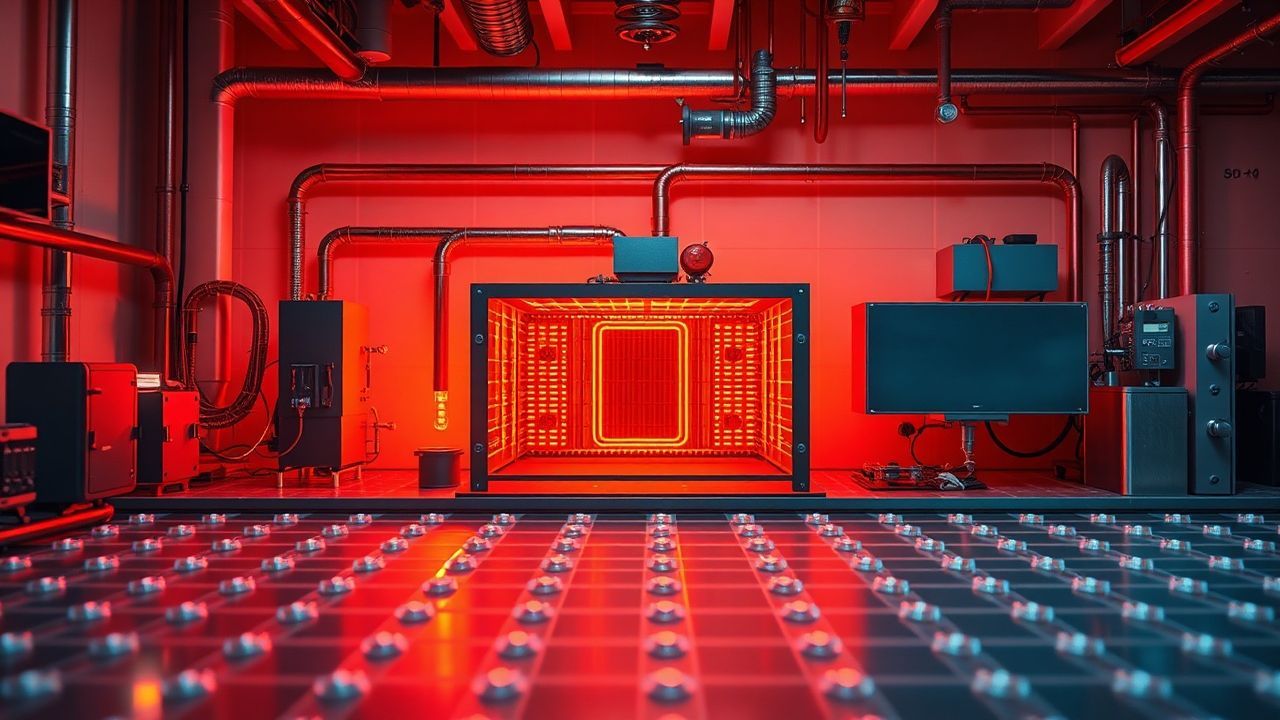

Heat capacity governs how materials absorb and release thermal energy. Engineers leverage this property to design storage that evens out supply and demand for heat and power.
- High heat capacity materials store more energy per degree of temperature change.
- Phase-change materials provide latent heat storage at nearly constant temperature.
- Thermal conductivity and insulation determine how fast energy flows in and out.
- Practical systems balance capacity, conductivity, cost, and lifecycle performance.
What is Heat Capacity?
Heat capacity is the amount of heat required to raise the temperature of a substance or object by one degree. It describes aggregate thermal storage potential and differs from the intensive property used in material selection.
The concept appears in thermodynamics and materials science and connects directly to energy storage design. See the formal definition on heat capacity (Wikipedia) for standard units and conventions.
Heat Capacity versus Specific Heat
The term specific heat (specific heat capacity) expresses heat capacity per unit mass and helps engineers compare materials on an equal basis. Using specific heat avoids misleading conclusions when system mass varies dramatically.
Specific heat links to material selection and sizing calculations when you estimate stored energy for a given temperature swing. Consult specific heat capacity (Wikipedia) for commonly tabulated values and measurement notes.
Units, Measurement, and Temperature Dependence
Specific heat is usually reported in J/g·K or J/kg·K; heat capacity for systems often uses joules per kelvin (J/K). Many materials show temperature-dependent heat capacity, so engineers use temperature-based curves rather than single numbers.
Laboratory calorimetry and calibrated sensors establish accurate performance data for system modeling. Accurate input data reduces risk when scaling from prototype to full system integration.
Key Materials for Thermal Storage
Material choice dictates stored energy density, release profile, and operating temperature range. Common options include water, molten salts, ceramics, and engineered phase-change materials (PCMs).
Phase-change materials store latent heat at near-constant temperature and suit load-shifting applications. Review the fundamentals on phase-change materials (Wikipedia) to match melting points and thermal cycles to your application.
High-Conductivity Additives
Graphene and carbon-based nanomaterials can dramatically increase thermal conductivity when dispersed correctly. Improved conductivity speeds charging and discharging but adds cost and processing complexity.
For background on carbon allotropes and their thermal properties see graphene (Wikipedia). Integrators weigh conductivity gains against dispersion challenges and safety procedures.
Designing a Thermal Storage System
A good design balances storage capacity, heat exchange rate, insulation, footprint, and lifecycle cost. Start with a clear performance requirement: many hours of storage or rapid buffer for short fluctuations.
Thermal conductivity and insulation govern how effectively stored energy moves and how long it stays. Read the principles on thermal conductivity (Wikipedia) to decide on conductive pathways and barriers.
Sizing and Modeling
Model energy flows using lumped-capacitance approximations for simple systems or finite-element models for spatial gradients. Use specific heat and mass to compute sensible heat storage and latent enthalpy for PCMs.
Include cycle degradation and real-world heat losses in the model. Conservative assumptions prevent oversizing components that later prove underperforming or costly.
Ingredients
Specify materials by thermal property, stability, and compatibility rather than evocative names. Typical ingredient categories include bulk storage media, PCMs, conductivity enhancers, structural supports, and insulation.
Choose materials rated for expected temperature ranges and chemical environments. Compatibility and fire-safety ratings matter for buildings and transportable units.
- Water (bulk sensible storage): High specific heat per unit mass and low cost.
- Phase-Change Materials (PCMs): Paraffins, salt hydrates, or bio-based PCMs for latent heat storage.
- Graphene / Carbon Additives: Improve conductivity for faster charge/discharge.
- Ceramic Composites: Structural stability at elevated temperatures.
- Nanoparticle Additives: Enhance surface area and convective exchange when used safely.
- Insulation Layers: Foam, aerogels, or engineered multilayer barriers to minimize losses.
Instructions
System assembly begins with a clear materials-handling plan and test protocol. Follow manufacturer safety data sheets and process controls when heating, mixing, or encapsulating materials.
Start with a controlled test cell to validate thermal performance before scaling. Monitor temperature profiles, phase transitions, and mechanical behavior over repeated cycles.
- Prepare the base medium: For sensible storage, fill a sealed tank with water or brine and instrument it for temperature and flow.
- Integrate PCMs: Encapsulate PCMs or embed them in a matrix to prevent leakage during melting and solidification cycles.
- Disperse conductive additives: Use mechanical mixing or functionalization to prevent agglomeration and ensure uniform conductivity.
- Assemble structural layers: Position ceramics or composites where mechanical loads and thermal gradients are highest.
- Apply insulation: Wrap the assembly with the specified insulating system to reduce standby losses.
- Instrument and test: Cycle the unit across the expected operating range and log thermal response and degradation markers.
Allow a staging period between prototyping and field deployment to refine control algorithms and mechanical interfaces. Iterative testing reduces operational surprises and lifecycle maintenance costs.
Tips for Success
Optimize heat exchange surfaces for the expected power levels; high capacity without matching surface area results in slow response. Balance storage capacity and power output for the intended duty cycle.
Design for maintenance access and end-of-life recycling. Materials selection that considers sustainability and reuse reduces long-term environmental impact and operating cost.
Monitor both capacity fade and thermal resistance growth over time. Scheduled diagnostics and a clear maintenance plan preserve performance and extend useful life.
Serving Suggestions
Integrate thermal storage with control systems that modulate charging during low-cost energy periods and discharging during peak demand. Visual dashboards and simple performance metrics increase operator confidence and system uptake.
For building-scale applications, embed storage within mechanical rooms and provide visible readouts for operators. For industrial systems, couple storage with process heat recovery and plant scheduling tools.
Performance Table: Representative Properties
The following values are representative ranges used for preliminary design and comparison. Use lab-verified data for final engineering calculations.
| Component | Heat Capacity (J/g·K) | Thermal Conductivity (W/m·K) | Role in Energy Storage |
|---|---|---|---|
| Water | 4.18 | 0.6 | Bulk sensible storage medium |
| Phase-Change Materials (PCM) | Variable (1.8–3.0) | 0.2–0.5 | Stores latent heat during phase transition |
| Graphene / Carbon Additives | 0.7–1.0 | 2000+ (material-dependent) | Enhances thermal conductivity when dispersed |
| Ceramic Composites | 0.8–1.0 | 1.0–3.0 | Structural stability at elevated temperatures |
| Nanoparticles | Material-dependent | Enhanced by surface area | Improves heat transfer and exchange rates |
Final Observations
Well-designed thermal storage systems turn material properties into reliable infrastructure assets. They require careful integration of capacity, conductivity, and controls to achieve predictable service.
Engineers and project owners should prioritize measured data, safety, and lifecycle planning. Small design choices—melting point selection, encapsulation strategy, and insulation thickness—often determine commercial success.
FAQ
What exactly is heat capacity?
Heat capacity measures the heat required to change an object’s temperature by one degree. It reflects total stored sensible energy and helps size storage volumes for a target temperature swing.
How does specific heat differ from heat capacity?
Specific heat is heat capacity normalized per unit mass and facilitates material-to-material comparison. Use specific heat to calculate energy stored per kilogram for a given temperature change.
Why use phase-change materials instead of plain water?
PCMs store latent heat at nearly constant temperature, offering higher energy density within a narrow operating window. They suit applications requiring temperature stability during charge and discharge.
When do I add high-conductivity additives?
Additives like graphene become valuable when the system requires rapid charge or discharge. Use them after verifying dispersion stability and considering cost and safety trade-offs.
How do I ensure long-term performance?
Adopt an instrumentation-led commissioning process, schedule thermal cycling tests, and track degradation metrics. Maintenance access and material recyclability also improve lifecycle value.
See also: heat capacity