
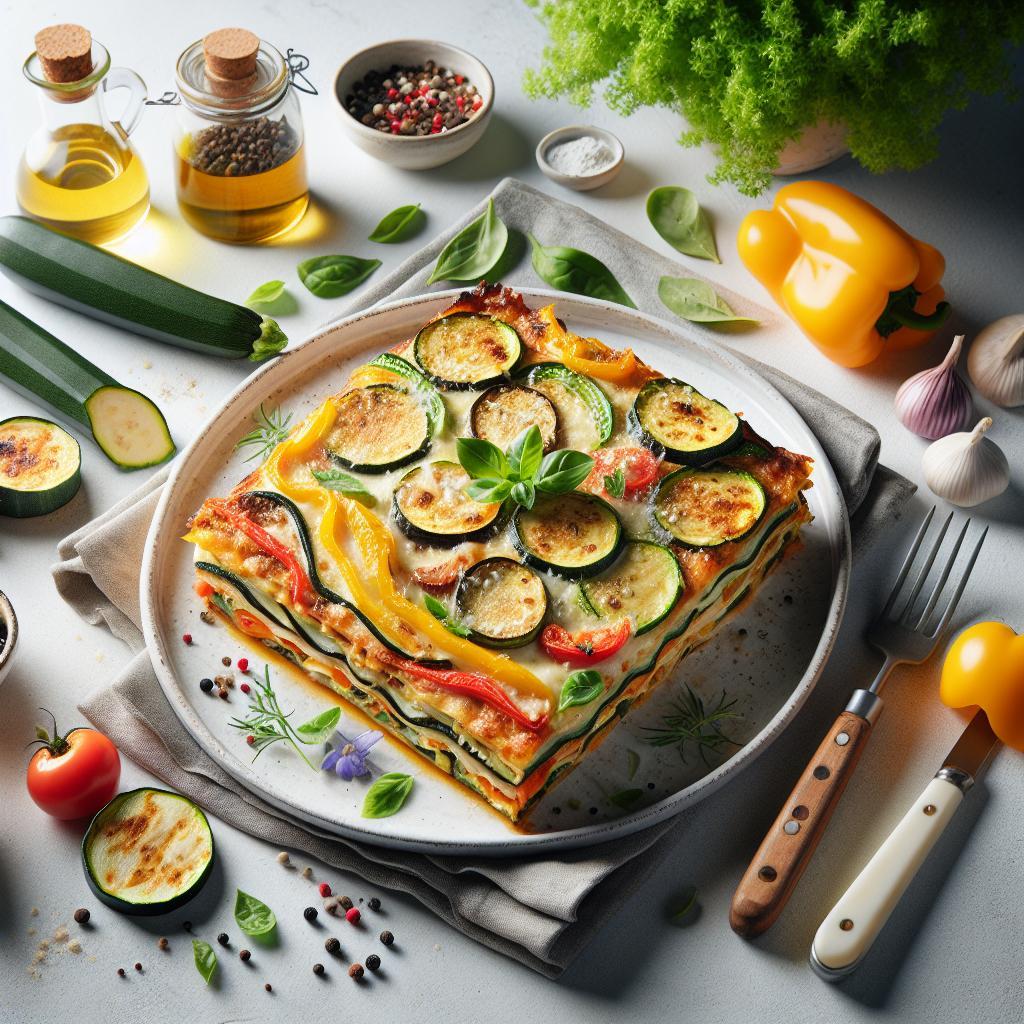

There’s a distinct alchemy when humble vegetables hit a hot pan—their natural sugars concentrate, edges caramelize, and textures deepen. Layer those roasted vegetables with tender pasta, rich béchamel, and melted cheese to build a lasagna that balances sweetness, savory depth, and creaminess.
- Prep and Cook Time
- Yield
- Difficulty Level
- Ingredients
- Instructions
- Tips for Success
- Serving Suggestions
- Nutrition per Serving
- Background & Notes
- FAQ
- What makes roasted vegetable lasagna different from traditional lasagna?
- Which vegetables roast best for this lasagna?
- How do I prevent a watery lasagna?
- Can I make this ahead of time?
- How should I store and reheat leftovers?
- Closing Remarks
- Roast hot, roast evenly: High heat concentrates flavor and encourages the Maillard reaction for caramelized edges.
- Layer with structure: A thin base of sauce prevents sticking and ensures clean slices when served.
- Make ahead: Roast and prepare sauces up to 24 hours in advance to simplify assembly and deepen flavor melding.
Prep and Cook Time
Total time reflects hands-on prep plus active roasting and baking. Timings assume use of no-boil noodles and a standard home oven.
Adjust for oven variance and vegetable density. Dense root vegetables may need a few extra minutes in the oven.
- Preparation: 30 minutes
- Roasting: 40 minutes
- Assembly: 20 minutes
- Baking: 35 minutes
- Total Time: 1 hour 55 minutes
Yield
This recipe yields 8 generous portions, ideal for family dinners or potlucks. It plates well for casual and formal service alike.
Leftovers reheat cleanly and often benefit from a short oven refresh to re-crisp the top.
Difficulty Level
Intermediate: The techniques required are straightforward, but success depends on precise roasting and sauce texture. These skills refine with practice.
If you are comfortable with a basic roux and oven timing, you will find this recipe very achievable.
Ingredients
The ingredient list focuses on seasonal vegetables and classic pantry staples to build distinct, balanced layers. Choose firm vegetables that hold shape when roasted.
Use high-quality cheeses and whole milk for a stable béchamel; low-fat dairy thins the sauce and affects the final mouthfeel.
- 2 medium zucchinis, sliced into 1/4-inch rounds
- 2 medium eggplants, sliced into 1/4-inch rounds
- 2 large red bell peppers, quartered and seeded
- 1 large yellow onion, thinly sliced
- 4 cloves garlic, minced
- 4 cups crushed tomatoes
- 2 tablespoons olive oil
- 1 teaspoon dried oregano
- 1 teaspoon dried basil
- Salt and freshly ground black pepper, to taste
- 12 no-boil lasagna noodles
- 3 cups whole milk
- 4 tablespoons unsalted butter
- 1/4 cup all-purpose flour, sifted
- 2 cups shredded mozzarella cheese
- 1 cup grated Parmesan cheese
- Fresh basil leaves, for garnish
Instructions
Follow these steps in sequence: roast the vegetables, build a tomato sauce, craft a smooth béchamel, then assemble and bake. Each step affects the final texture and flavor balance.
Keep the oven at the specified temperatures and let the lasagna rest before slicing to ensure tidy portions.
Roasting Vegetables
Preheat your oven to 425°F (220°C). Arrange zucchini, eggplant, and bell peppers on baking sheets; toss with olive oil, salt, pepper, and half the dried herbs.
Roast for 35–40 minutes, turning once. The goal is golden, caramelized edges; this intensifies sweetness and creates depth through the roasting process.
Tomato Sauce
In a saucepan over medium heat, sweat the onion and garlic in one tablespoon of olive oil until soft, about five minutes. Add crushed tomatoes, the remaining oregano and basil, and simmer gently for 20 minutes.
Adjust salt and pepper toward the end. A well-seasoned tomato layer anchors the lasagna and prevents a flat finish.
Béchamel Sauce
Warm the milk slightly to avoid shocking the roux. Melt butter over medium heat, whisk in sifted flour, and cook for two minutes to form a blond roux.
Gradually whisk in warm milk, stirring until the sauce coats the back of a spoon, seven to ten minutes. Season lightly with salt and a pinch of nutmeg for classic balance; this is the creamy binder.
Assembly & Baking
- Lower oven to 375°F (190°C). Spread a thin layer of tomato sauce on the dish base to prevent sticking. Arrange three no-boil noodles over the sauce.
- Add roasted vegetables in an even layer, spoon more tomato sauce, and drizzle béchamel. Sprinkle mozzarella and a light dusting of Parmesan. Repeat to build three layered tiers.
- Cover with foil and bake 25 minutes. Remove foil and bake 10 more minutes until bubbling. For an extra crust, broil 1–2 minutes, watching continuously to avoid burning.
- Rest 15 minutes before cutting. Resting allows the béchamel to set and produces clean slices.
Tips for Success
Small technique choices make a big difference. Cut vegetables uniformly to ensure consistent roasting and even layering.
Use warm milk for the béchamel to prevent lumps and whisk steadily when adding liquid to the roux.
- Even cuts: Match thickness across vegetable types for uniform doneness.
- Salt strategically: Season roasted vegetables before roasting and adjust sauce seasoning after reducing.
- Make-ahead: Roast and store vegetables and sauces up to 24 hours for streamlined assembly.
Serving Suggestions
Serve warm with a scattering of fresh basil and a light drizzle of good olive oil to add brightness. A crisp green salad tossed with lemon vinaigrette complements the dish by cutting richness.
For wine, choose a medium-bodied red like Chianti or a fruity Pinot Noir; alternately, a dry, herbaceous white can lift herbal notes from the basil and tomato.
Nutrition per Serving
Estimated nutrition reflects typical ingredient choices and portion sizes. Values will vary with precise brands and substitutions.
Use reduced-sodium tomatoes or lower-fat dairy to alter nutrition profile, but expect changes in texture when changing fat content.
| Nutrient | Amount per Serving |
|---|---|
| Calories | 385 kcal |
| Protein | 18 g |
| Carbohydrates | 44 g |
| Fat | 15 g |
Background & Notes
This vegetable-forward approach leans on methods from classical pasta and sauce preparation. The béchamel links to French sauce tradition, while the layered format traces back to traditional lasagne constructions.
Roasting adds concentrated flavor distinct from sautéing; when combined with a creamy binder, it creates a satisfying meat-free centerpiece suitable for diverse menus.

FAQ
Below are common questions that arise when preparing roasted vegetable lasagna. Answers focus on technique and practical adjustments.
Refer to the linked topics for deeper context on methods and ingredients.
What makes roasted vegetable lasagna different from traditional lasagna?
Roasted vegetable lasagna emphasizes caramelized vegetables instead of meat and ricotta. Roasting concentrates sugars and builds savory complexity.
That concentrated vegetable flavor pairs with béchamel and tomato to create a layered, textured dish that appeals broadly, including to vegetarian diners.
Which vegetables roast best for this lasagna?
Firm, low-moisture vegetables like zucchini, eggplant, bell peppers, and root vegetables stand up well. Choose produce that browns without turning to mush.
Rotate cuts so pieces are uniform. For seasonal variety, consider adding mushrooms or squash to expand umami and color.
How do I prevent a watery lasagna?
Drain or salt high-moisture vegetables briefly before roasting to reduce released liquid. Use a thin first layer of sauce to avoid excess moisture at the base.
Allow the lasagna to rest after baking; the internal steam redistributes and the béchamel firms, producing cleaner slices.
Can I make this ahead of time?
Yes. Roast vegetables and prepare sauces up to 24 hours in advance. Assemble the lasagna, cover, and refrigerate until ready to bake.
When baking from chilled, add 10–15 minutes to the covered baking time to ensure it heats through evenly.
How should I store and reheat leftovers?
Store cooled leftovers in an airtight container in the refrigerator for up to 4 days. Reheat individual portions in a 350°F (175°C) oven for 12–15 minutes to refresh the crust.
Alternatively, cover and microwave on medium power for a short interval, then finish briefly in a hot oven for a crisped top.
Closing Remarks
Roasted vegetable lasagna rewards careful roasting, balanced seasoning, and patient assembly. Each technique—from triggering the Maillard reaction to building a stable béchamel—contributes to a cohesive final dish.
Experiment with seasonal produce and modest substitutions to keep the recipe relevant year-round. The result is a satiating, vegetable-forward lasagna that holds its own on any table.
Further context on herbs and classical sauces can help refine your approach: consult entries on béchamel sauce and basil for technique and pairing notes.
See also: Vegetable Lasagna