
By using this site, you agree to the Privacy Policy and Terms of Use.
Accept
CookOrBitCookOrBitCookOrBit
  • Home
  • About Us
  • Ingredient Science
    • Flavor & Aroma
    • Protein Chemistry
    • Sugar & Starch
    • Fats & Emulsions
  • Cooking Techniques
    • Searing & Grilling
    • Baking & Roasting
    • Boiling & Steaming
    • Low & Slow
  • Kitchen Experiments
    • DIY Ferments
    • Flavor Tests
    • Gadget Testing
    • Molecular Gastronomy
  • Food Myths
    • Searing Myth
    • 5-Second Rule
    • MSG Myths
    • Microwave Myths
  • Tools
  • More
    • Extra Picks
    • Quick & Easy
      • Breakfast Ideas
      • Desserts
      • Snacks
      • Soups
    • Global Flavors
      • Asian Street Eats
      • Latin Comforts
      • Mexican Flavors
      • Modern Mediterranean
CookOrBitCookOrBit
  • Home
  • About Us
  • Ingredient Science
  • Cooking Techniques
  • Kitchen Experiments
  • Food Myths
  • Tools
  • More
Search
  • Home
  • About Us
  • Ingredient Science
    • Flavor & Aroma
    • Protein Chemistry
    • Sugar & Starch
    • Fats & Emulsions
  • Cooking Techniques
    • Searing & Grilling
    • Baking & Roasting
    • Boiling & Steaming
    • Low & Slow
  • Kitchen Experiments
    • DIY Ferments
    • Flavor Tests
    • Gadget Testing
    • Molecular Gastronomy
  • Food Myths
    • Searing Myth
    • 5-Second Rule
    • MSG Myths
    • Microwave Myths
  • Tools
  • More
    • Extra Picks
    • Quick & Easy
    • Global Flavors
Follow US
  • Advertising Policy: 10 Practical Rules for Safe, Compliant Ads
  • Contact Us
  • Cookie Policy: Clear Guide for Site Owners
  • Copyright Notice Guide: 7 Essential Rules for Website Owners
  • Disclaimer
  • Privacy Policy
  • Terms of Service
By Fimaw.com
- The Mystique of Smoke Rings: How Vortices Take Shape
CookOrBit > Blog > Cooking Techniques > Searing & Grilling > 7 Expert Secrets: The Mystique of Smoke Rings and How Vortices Take Shape
Searing & Grilling

7 Expert Secrets: The Mystique of Smoke Rings and How Vortices Take Shape

William J. Kroll
By William J. Kroll
Published: September 30, 2025
Share
SHARE

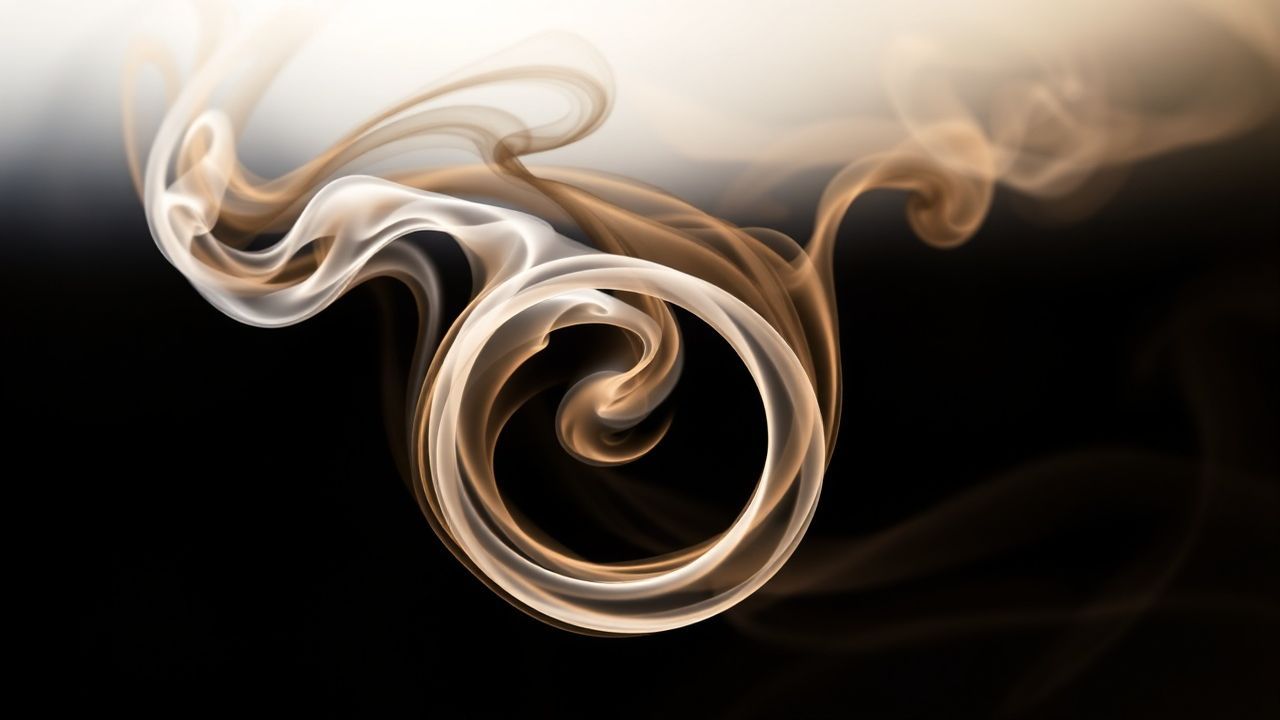
Watching a perfect smoke ring drift through the air reveals a compact lesson in fluid mechanics and vortex dynamics. These rings behave as miniature, self-preserving whirlwinds; they form, travel, and decay under predictable physical rules.

Contents
  • What a smoke ring is
  • Core physics of vortex formation
    • Key mechanics in plain terms
  • Practical method: forming reliable smoke rings
  • Tips for repeatable results
  • Applications and observed analogues
  • Key takeaways
  • FAQ
    • How long do smoke rings typically last?
    • Can smoke rings be large?
    • Are smoke rings unique to smoke?
    • What factors ruin a ring?
    • Is it safe to use smoke rings in culinary service?
  • Vortex structure: smoke rings are toroidal vortices that retain coherence while spinning.
  • Control factors: ring size and lifetime depend on pulse force, aperture shape, and humidity.
  • Practical use: chefs and artists use rings for aroma delivery and visual effect.
  • Science link: the same mechanics appear in fluid dynamics and aerodynamics.

What a smoke ring is

A smoke ring is a toroidal vortex: a donut-shaped circulation of fluid or gas that traps particles and moves as a coherent structure. You see the particles because smoke makes the flow visible; the vortex itself consists of rotating air.

Scientists describe these structures as vortex rings, and their properties connect directly to classical fluid dynamics. For a concise technical reference, read the vortex ring entry on Wikipedia.

- Advertisement -

Core physics of vortex formation

When a short, concentrated pulse of fluid passes through a circular opening, shear between the moving core and the ambient fluid produces rotation at the edge. That rotation wraps the flow back on itself, closing the cylinder into a ring and forming a stable vortex structure.

Viscosity, pulse duration, and the geometry of the aperture set the ring’s initial momentum and stability. These factors fall under general fluid dynamics principles and determine how long a ring remains coherent.

Key mechanics in plain terms

The ring’s outer layer moves more slowly than its inner core, so the flow rolls backward and locks into a torus. This rotation reduces radial diffusion and keeps the particulate smoke concentrated along the ring’s edge.

- Advertisement -

Engineers quantify these effects with nondimensional numbers such as the Reynolds number, which indicates when inertial forces dominate viscous dissipation. Higher Reynolds values generally support longer-lived rings in air.

Practical method: forming reliable smoke rings

Generate clean, dense smoke and channel it through a smooth circular outlet. A glass jar or short pipe with a polished rim produces predictable results because the edge promotes uniform shear during the puff.

Use a short, controlled burst from the diaphragm delivered through an “O”-shaped mouth or a small aperture. Practice timing until the ring detaches cleanly; the best pulses last roughly half a second for typical tabletop setups.

- Advertisement -

For culinary or presentation contexts, prepare in advance: soak wood chips, stabilize your smoke source, and keep a humidifier nearby for controlled humidity. For step-by-step techniques tailored to food presentation, see our internal guide on culinary vortex techniques.

To deepen your understanding of flow behavior in demonstration setups, consult our primer on fundamental patterns at vortex dynamics basics. These pages provide repeatable drills for consistent ring size and timing.

💡 Expert Insight
Expert Insight: When you want longer-lived rings, increase smoke density and raise local humidity slightly. Denser particulate loads and a thin moisture film on particles slow diffusion and keep the vortex visible longer.

Tips for repeatable results

Control three variables: aperture geometry, pulse energy, and smoke density. Small changes in rim shape or pulse strength shift ring diameter and stability in predictable ways.

Work in still air. Drafts and convective flows destroy the delicate balance that sustains a vortex ring. Set up experiments away from vents and open windows to measure performance consistently.

⚠️ Pro-Caution
Pro-Caution: Avoid prolonged inhalation of smoke and never use treated or chemically altered materials to produce smoke. Perform demonstrations in well-ventilated spaces or use filtered systems to protect respiratory health.

Applications and observed analogues

Tiny vortex rings mirror larger phenomena across nature and engineering. Marine mammals produce bubble rings underwater; volcanic eruptions sometimes emit large toroidal ash rings; and researchers study rings to better model jet flows.

These parallels make smoke rings useful teaching tools. The ring isolates key behaviors—entrainment, stability, and decay—making them accessible analogues for fields like aerodynamics and propulsion.

Observe rings with backlighting to reveal shear layers and core vorticity. Photograph sequences can show how circulation strength falls off and how ambient turbulence increases ring breakdown.

For underwater comparisons, the physics aligns with bubble rings. See the bubble ring entry for visual similarities and formation mechanisms at bubble ring.

Key takeaways

Smoke rings serve as compact demonstrations of vortex physics and fluid transport. They form from short pulses through a circular opening and persist while rotation suppresses radial mixing.

Control aperture edge, pulse duration, and smoke density to shape ring size and lifetime. Prioritize safety and ventilation when producing smoke in any setting.

FAQ

The following questions answer common practical and scientific queries about vortex rings. Each response focuses on clear, actionable information.

How long do smoke rings typically last?

Lifetime depends on initial momentum, smoke density, and ambient turbulence. In calm, moderately humid air, rings commonly persist three to five seconds before visible breakup.

Introducing slight humidity and denser smoke extends visibility by reducing particle evaporation and diffusion. Strong drafts will shorten lifetime sharply.

Can smoke rings be large?

Yes. Ring size scales with aperture diameter and pulse energy. Larger apertures and stronger, well-shaped pulses produce bigger rings, but they require more momentum to remain coherent.

Generating very large rings indoors demands careful control of air currents and a stable smoke source. Open outdoor demonstrations face wind-driven instability unless performed in still conditions.

Are smoke rings unique to smoke?

No. The underlying vortex mechanism appears whenever a pulse of fluid passes a circular rim. Examples include bubble rings underwater and ring vortices in propulsion jets.

These analogues demonstrate similar formation physics despite differing media and scales, which makes rings valuable for comparative study across disciplines.

What factors ruin a ring?

Turbulence and shear from surrounding flow destroy ring coherence. Improper pulse shape yields partial rings or vortices that shed vorticity irregularly and collapse faster.

Contaminants that change particle size or introduce heat gradients can also accelerate decay. Maintain consistent smoke generation and stable ambient conditions for best results.

Is it safe to use smoke rings in culinary service?

Yes, if you use clean, food-grade materials and limit guest exposure. Use organic wood chips and ensure the dining area remains well-ventilated to minimize inhalation risk.

Document the materials you use and inform staff and guests. For repeated service, consider smoke-generating devices with filtration to reduce particulate load.

Internal resources: try our culinary vortex techniques and vortex dynamics basics pages for drill exercises and controlled experiments to build reliable results.

See also: smoke rings

Irresistible Velvety Instant Pot Potato Soup — 40-Minute Cozy Comfort
Unlocking Flavor: 10 Expert Ways to Make Vegetarian Meals Feel Complete
Mustard Mastery: 9 Science-Proven Ways to Stabilize Mustard Emulsions
7 Powerful Reasons Resting Steak Boosts Juiciness (Don’t Rush Resting Steak)
Velvety Broccoli Soup: 7 Expert Tips
TAGGED:aerodynamicsandculinary presentationfluid dynamicsmystiquesmokesmoke ringssmoke visualizationthevortex dynamicsvortex rings
Share This Article
Facebook Pinterest Whatsapp Whatsapp LinkedIn Telegram Threads
What do you think?
Love0
Sad0
Happy0
Sleepy0
Angry0
Dead0
Wink0
Previous Article - Crisp Science: Unlocking the Chemistry of Perfect Tempura Crisp Science: 7 Precision Steps to Perfect Tempura
Next Article - Unlocking the Magic: What Is a Springform Pan? Springform Pan Secrets: 7 Expert Uses & Baking Tips
Creamy Garlic Chicken with melted Parmesan and fresh herbs on a rustic white plate
Garlic Chicken: 7 Ultimate Brilliant Recipes to Make the Best-Ever Creamy Garlic Chicken with Parmesan & Fresh Herbs
Extra Picks
Colorful bowls of Leftover Couscous transformed into salads, fritters, and stuffed peppers.
12 Amazing Practical Leftover Couscous Ideas: Brilliant Ways to Reuse and Remix
Uncategorized
Colorful jars of spice blends beside steaming couscous with herbs and lemon
7 Ultimate spice blends That Transform Your Couscous — Amazing Best Flavor Boosts
Uncategorized
Bowls of gluten-free couscous alternatives: quinoa, millet, cauliflower, and rice
10 Amazing couscous alternatives: Best Gluten-Free Swaps for Incredible Flavor
Uncategorized

Tags

and art baked baking science baking techniques Baking tips batch cooking beef behind butternut squash caramelization cast iron skillet chemistry chicken comfort food Cooking science cooking technique Cooking techniques Cooking tips crafting creamy creamy soup crispy culinary science fish flavor flavor chemistry food food safety Food science for garlic golden Ground turkey hearty heat high-heat cooking high protein meals how instant read thermometer lactic acid bacteria Lean protein magic Maillard reaction make ahead meals make ahead soup mastering meal prep Meal prep recipes meat thermometer microwave microwave cooking moisture control one pot meals Pan searing perfect perfectly Plant based protein Probe thermometer protein denaturation Quick dinners roasted roasted squash roasted tomato soup Roasted vegetables Roasting techniques savor savory science Searing technique Searing techniques secrets slow cooking squash steak steak cooking sweet temperature control the top turkey turkey soup turkey stew ultimate umami cooking umami flavor unlock unlocking unveiling vegetable velvety weeknight dinner Weeknight dinners weeknight meals what when why with your zesty
March 2026
M T W T F S S
 1
2345678
9101112131415
16171819202122
23242526272829
3031  
« Feb    

You Might Also Like

Hearty Baked Fish Stew: A Savory Ocean Delight Recipe
Extra Picks

7-Point Hearty Baked Fish Stew: Ultimate Savory Ocean Recipe

William J. Kroll
William J. Kroll
January 20, 2026
- Brew Bliss: Mastering the Art of Homemade Kombucha
DIY Ferments

Brew Bliss: 10 Proven Steps to Master Homemade Kombucha

William J. Kroll
William J. Kroll
November 1, 2025
Chickpea Salad Sandwiches: A Creamy, Crunchy Delight
Extra Picks

7 Easy Chickpea Salad Sandwich Recipes: Creamy, Crunchy Lunch Ideas

William J. Kroll
William J. Kroll
January 16, 2026
Listeria Uncovered: The Silent Threat in Your Food Chain
5-Second Rule

Listeria Uncovered: 7 Essential Food Safety Steps

William J. Kroll
William J. Kroll
February 12, 2026
- Searing Science: The Chemistry Behind Stainless Steel Pans
Searing & Grilling

Searing Science: 7 Chemistry Secrets Behind Stainless Steel Pans

William J. Kroll
William J. Kroll
November 4, 2025
Chia Seed Pudding: A Nutritious Delight in Every Bite
Extra Picks

Chia Seed Pudding: 7 Proven Ways to Make It Creamy & Nutritious

William J. Kroll
William J. Kroll
December 21, 2025
Follow US
By Fimaw.com © All Rights Reserved.
  • Advertising Policy: 10 Practical Rules for Safe, Compliant Ads
  • Contact Us
  • Cookie Policy: Clear Guide for Site Owners
  • Copyright Notice Guide: 7 Essential Rules for Website Owners
  • Disclaimer
  • Privacy Policy
  • Terms of Service
Welcome Back!

Sign in to your account

Username or Email Address
Password

Lost your password?